HI, and welcome to my blog! I am a field guide in a private game reserve in South Africa and below you will find stories and pictures of my amazing job!

March 4, 2013

This! Is! Sparta!

          Ok, so the line from 300 might be a little cheesy or perhaps even lost on some of you but the parallels are rather relevant at the moment.  The dynamics of the lion population at Sabi Sabi has been crying out for change of late.  The epic nature of the Southern Pride’s reign has limited the movements of the other prides in the area for many years now.  They have in fact been responsible for reducing the neighbouring Charleston pride to just 1 lone female and her 2 sub adults only last year.  In keeping with the title of the blog, they are the equivalent of the Persians, conquering all before them, under the guidance of their king, Xerxes.  Xerxes was one man, whose confidence and success in battle was mainly due to the fearsome nature of his loyal 150,000 strong army.  In the microcosm that is Sabi Sabi, the Kruger male has been able to expand and more importantly, hold his territory thanks to the unstoppable force that is the mighty Southern Super Pride.  A pride of 18 lions is a fearsome unit and thus far has ruled the southern Sabi Sands with unwavering ferocity.

The Kruger male sports a nasty scar on his nose probably sustained during a feeding frenzy


The eyes of the Kruger male miss nothing


The KNP male emerges from the darkness on another territorial patrol

          However, in recent weeks, the area has seen the arrival of 2 new players.  The Sparta males from the east have been launching forays deeper and deeper into the Southern Pride’s territory.  An interesting coalition consisting of 2 unrelated males, one a magnificent male in his prime, the other a young warrior, fast maturing into a supreme specimen, the Sparta males seem to mean business.  The growing strength and confidence of the younger male has no doubt sparked this latest activity.  He seems to be exerting dominance over his elder partner and his desire for a territory of his own is obvious.  When the pair are on the move, it is always the younger that takes the lead.  Youthful exuberance and fearlessness seems to be driving the pair to confrontation, with the elder member being swept up in the occasion. 

The younger of the Spartans mounts his older associate in a show of dominance


One of the Spartan's attention is attracted by noise in the grass close by


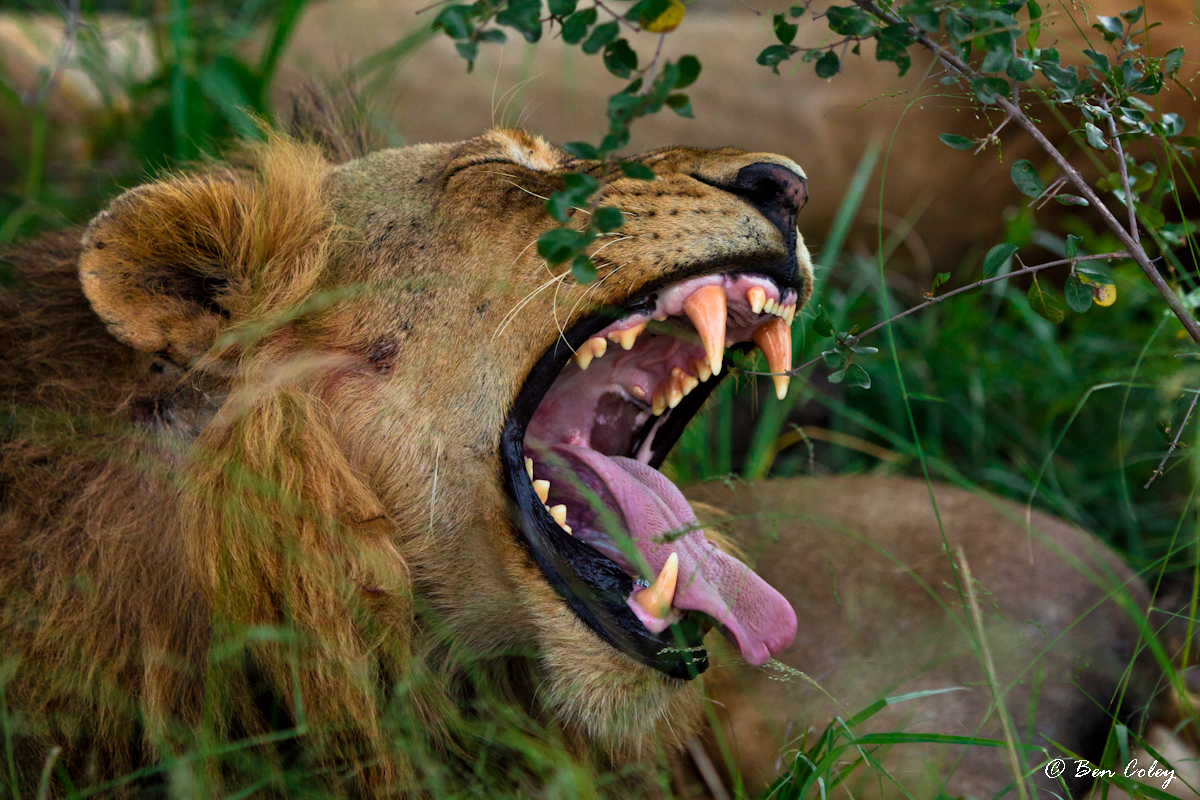
The younger Spartan shows off his fearsome arsenal

          For the lone Kruger male, this invasion could spell disaster for his reign as experience can only account for so much.  After a while, the math becomes self-explanatory: in a 2 vs. 1 confrontation, the mighty KNP male’s match may well be met.  However, the KNP has not been king for nearly 2 years without his share of cunning.  Since the arrival of the Spartans, he has not left the side of the pride, safe in the knowledge that even with 2 males hunting him down, the protection of Mandleve and the other 6 females is invaluable.


Mandleve and her cubs play in the road


Mandleve shrugs off her cubs' affectionate advances


One of the Southern Pride females hurdles a cub as she dismounts a fallen marula tree


The Southern Pride youngsters play on a fallen marula tree

          The Spartans must rely on a divide and conquer strategy to survive.  If they can separate the KNP male from his battalions, they stand a good chance of taking over the prime territory of the Southern Pride and the rich breeding opportunity the females present.  During the past weeks, the Spartans have ventured deep into the pride’s home and have been heard roaring and scent marking – an unmistakable challenge to the current king.  The bold nature of the takeover bid matches the self-confidence shown by king Leonidas’ small, but elite, fighting force to hold the Persian hoards at bay against all odds.  However, if and when the 2 armies meet, the spectacle promises to be far more explosive than Hollywood can convey!  The Spartans must rely on cunning to succeed and timing is key.  The Southern pride are masters tacticians however and have continued to avoid the advancing Spartans.  Their ploy of unity has caused trepidation amongst the Spartans.  The sound of the Kruger male’s battle cry in tandem with 7 adult females and 6, more than competent, sub-adults has caused the Spartans to retreat for now.  They are still inside the territorial boundary but seem to buying time to work out their strategy.  No victory will be forthcoming against greater numbers with rash decisions.


The younger Spartan's mane is developing fast


The other Spartan gives us a great side profile shot


Ever alert, the older Spartan scans the horizon

          What promises to play out soon within the battle ground of Sabi Sabi is all out war.  Should the Spartans succeed in usurping the KNP male, it will bring about a fascinating twist in our dynamics.  The 4 sub adult males will be chased away for certain and the fate of the 4 cubs, losing the protection of their father, will be a foregone conclusion.  Or will it?  The Southern pride has proved time and time again that the females are a formidable force even without the presence of a male.  For those of you that are unaware, the 6 sub adults in the pride are no relation to the KNP male.  When he and his now deceased brother took control of the area some 2 years ago, they tried in vain to eradicate the genetics of its former rulers.  The cunning and strength of the females eventually culminated in them adopting the 6 cubs and raising them as their own.  This is highly unusual in the harsh world of lion population dynamics and proved beyond all doubt that these females are not to be underestimated.  Perhaps the same thing will happen this time around?  After all, the Spartan army managed to continue to defy the odds despite the loss of king Leonidas at the hands of the Persians…  Perhaps the pride will split?  Perhaps the KNP male will form a coalition with the 4 sub adult males?  The possibilities in the infinity choices of nature are fascinating and we wait with baited breath for the outcome of the mighty battle that is soon sure to rage

February 18, 2013

Fear of the Dark

          Fear of the unknown is probably the only phobia that affects every single person on the planet.  There are many irrational fears peppered through the psyche of the everyday man (or woman) on the street but most are borne of unpleasant past experiences.  What has enabled human beings to rise to an unsurpassed intellectual plane is the capacity of the brain.  The gift of imagination has granted us the ability to invent ground breaking technology and to surpass nearly every hurdle that mankind has faced.  However, this talent has a flipside.  The power of imagination is so potent that it is capable of destroying lives and reducing the strongest of men to gibbering wrecks.  These terrifying thoughts generally need a catalyst, and the most commonly responsible is the dark.


          From an early age, fear of the dark has plagued young children.  Sleepless nights wondering what monsters await under the bed or what manner of aberrations reside inside the closet are common place.  As a youngster, I myself refused to sleep with a limb hanging off the bed due to an irrational fear of having it bitten off by a fanged menace loitering in the shadows under my mattress.  Even noises that are heard during the daylight hours and ignored are transformed by darkness into the ominous footsteps of objects of our own fear.  The human world is so dictated by its ability to see and analyze what is seen, that when that sense is removed, the true power of the brain is unleashed.  And such monumental creative power is hard to control.  Let’s not forget that fear of the dark has its roots from early man when we were perceived as prey by all manner of fearsome beasts that roamed through the shadows of night.  The discovery of fire was hugely influential in primitive engineering circles but perhaps more than anything, it gifted man the ability to overcome darkness and keep perceived and very real dangers at bay.


          The bush is home to some of the most feared land predators in the world today.  The power and reputation of the lion, the speed and guile of the leopard and the sinister hyena all ply their trade under the cloak of darkness.  Viewed during the day, the cats especially are often construed as large kittens and many a guest has wanted to rub the belly of a sleeping lion as it dozes through the daylight hours.  However, once darkness begins to envelop the land, these nocturnal nemeses come to life and undergo a transformation as extreme as that of a caterpillar to a butterfly, perceptually at least.  The inky shroud that drapes itself across the landscape transforms these slumbering felines into efficient killing machines.  Blackness is their ally.  Their behaviour changes, their demeanor changes, our perception of them changes. 


          When we view cats at night, that primal fear is once again resurrected by the Cimmerian shade overwhelming us and these magnificent creatures come into their own.  The comfort and warmth offered by the Sun has deserted us and instead, the brain starts to recall all the horror movies it has witnessed, adrenaline levels rise and the infinite power of their imagination is released.  The darkness seems to invade every pore in our skin and systematically undo all our common sense and principles.  It is the feeling of hopelessness and helplessness that the absence of light brings.  The knowledge that their eyes are able to penetrate the gloom with consummate ease; that these predators must kill to survive and that we ourselves could become prey lend itself to a very different experience.  


           At Sabi Sabi we are blessed with wonderful levels of habituation and when a 200kg male lion stalks past the open land rover only a few metres away, the inhabitants hold their breath as one.  Men, women and children alike shift slightly in their seats to put distance between themselves and the superior specimen.  When it makes eye contact with you, even though the spotlight is illuminating its visage, the feeling of insignificance is hard to shake.  The uncomfortable knowledge that you are being evaluated by a killing machine whose eyes seem to look right through your skin and into your very soul is a profound experience.  Your conscience struggles to balance the feelings of wonder and respect with that of ancient fear and the primordial instinct to survive.


          The ability to slink through the shadows without a sound yet seeing everything has enabled these great predators to thrive.  The psychological advantage that they possess over their quarry is as old as life itself.  Darkness always has and always will carry with it the stigma of danger.  Throughout history and every religion in the world, darkness is seen as a bad omen.  The lack of depth perception, the inability to evaluate a situation in relation to its surroundings and the feeling of cold isolation all play a part in amplifying the power of darkness.  Surviving a day in the bush is a far different prospect to that of surviving the night.  The playing field flips and all of the senses and skills that enable us to flourish under the comforting companionship of the sun are removed and those that relish the darkness come to the fore.


          Just because the majority of organisms on Earth need the sun to prosper, it does not mean that those who crave the sanctuary of darkness should be seen as evil.  Everything in nature has its balance.  Without some species being able to flourish in darkness, a perfectly good ecological niche would be wasted and the balance would be upset.  One cannot exist without the other.  To paraphrase the great Chinese philosopher Laozi, nothing exists in isolation.  For life to exist there must be balance. This implies the harmonic existence of two things or what philosophers call ‘duality’.  Man has woman, heat has cold, good has bad and light has darkness.     


February 8, 2013

The Return of the King


          A lone silhouette silently padded towards us.  The backlight from the second vehicle cast an eerie glow around a muscular physique and sand puffed up from under powerful paws as they glided down the road.  Sandriver was back.  Over a year ago, this mighty specimen was dethroned as the king of the entirety of Sabi Sabi by a younger male we have come to know as Xihangalas; but times have changed.  Xihanagalas has not been seen very much over the past few months and news of his absenteeism had been quick to reach the former ruler.  No longer did the breeze from the east carry with it the familiar scent and territorial calls of his old adversary as it had done before.  The door had been opened and the old warrior did not need a second invite to walk through.


          His posture and attitude said it all.  Fearless of any foe that he might meet as he moved deeper into his old territory, stopping to call and scent mark every few hundred meters, there was no doubt that he was making a play for his old domain.  The lonely life of a leopard is harsh but Sandriver walked with a confidence that comes from self reliance and he looked good with it.  Full belly and velveteen coat left no doubt that he was still at the top of his game, regardless of his one handicap.  His blind right eye, opaque in colour, glowed like mercury as the powerful spotlight rays glinted off it; a daily reminder of the titanic battle that waged against his younger conqueror all those months ago.  The metallic quality, coupled with the aura of authority oozing from him made think of the Terminator movies – a lone warrior whose indestructibility meant that, regardless of superficial injury, he was as efficient a killing machine as ever.


          We followed him through the reserve, as he delved deeper into his former territory.  His internal GPS seemed to suffer no consequences as at no point did he stop to evaluate his position.  A leopard’s knowledge of every inch of his domain is essential: knowing the best hunting grounds and escape routes should he encounter marauding lions on his travels.  

          Every so often he would stop and cock his head to listen.  As we strained to match the acuteness of his hearing, we heard the faint but familiar rasping sound of another leopard in the distance.  Sandriver’s pace quickened and his level of territorial activity increased as he made a beeline in the direction of the challenge.  He began to drool, saliva hanging from the corners of his mouth, a typical response in leopards to heightened emotions.  The smell of his pheromones wafted through the night’s air.  Best equated to the smell of popcorn, this aroma contains all the information another leopard needs to evaluate the individual.  Routinely he stopped at bushes to wipe glands situated on the side of his face and his paws on to the leaves, leaving no doubt to others that he was back. 


          Occasionally he lay down to rest, but never for long.  There was business to attend to and old scores to settle.  The other male’s calls grew louder as he closed in on their location.  Silently he drifted across the savanna but a leopard’s instinct never sleeps.  As if to prove to us, and anyone else watching, that his compromised vision did not hinder him, moments later his good eye focused on something on the ground close by.  In the blink of an eye, his toned legs propelled him through the air as he pounced on a petrified scrub hair.  The 75kgs of feline perfection made short work of the snack and the entire hare was dispatched in a few minutes, fur, bones and all.  But there was no time to savour the flavour as Sandriver continued his relentless march.


          Time was against us however and forced us to return to the lodge salivating at the prospect of what we might find the nest day.  We know that the calls heard by the old king were coming from the Mahlathini male and only time will tell if Sandriver’s confidence and experience will be enough to subdue to new sovereign of the north, or whether youthful self belief will be enough to keep the old campaigner at bay.  For those of us who have been at Sabi Sabi for a while, to see Sandriver’s return was a real treat.  It just goes to show that nothing in nature is finite and that the dynamics of territories and dominance are not set in stone.  Whilst we revel in change, a large part of me wants to see Sandriver’s empire return to its former glory and I cannot wait to witness to no doubt turbulent struggles that will accompany it!


December 30, 2012

Survival of the Quickest

          But for a few notable exceptions, animals are not known for their problem solving abilities.  Most rely on primeval instinct that has been passed on to them through generation after generation.  The knowledge of what to do and when is as natural for them as is taking their next breath.  This instinct courses through their veins like a river and they react to stimuli without thought and without control.  One urge overrides all others in the natural world however and that is maternal instinct: the need and desire to produce, provide for and protect the next generation:  to ensure genetic survival.  A mother’s ability to feed off this preordained behaviour is unsurpassed and last night, we were privy to one such event as a mundane sighting turned into a breathtaking example of just how unscripted the bush can be.

          That morning, we had been fortunate enough to find the Nottins female scouring the lush vegetation for a much needed meal.  Not only for her, but with a cub at age 8 months hidden somewhere in the surrounding area, her need to find sufficient food is essential to ensure safe passage to adulthood for her legacy.  The relaxed nature of this particular leopard allowed us into her world and we followed her as she meandered through the undergrowth searching for an opportunity that might allow her to provide nourishment for her prodigy.  The level of concentration was evident from her behaviour as she routinely stopped and scanned the area, alert to any opening that her lighting reactions and centuries of honed instinct could exploit.  Bright sunshine however is not where her advantage lies and although well equipped to prosper in any condition, her search ended in vain and we left her slumbering in the shadows as the temperatures grew to unbearable heights and we too bade a hasty exit to avoid the harsh rays of the African sun.


          Later that evening she was spotted again and I made a bee line for the area, keen to see how she had fared during the fading light and to add another chapter to my guests’ experience.  As I arrived at the sighting I was disappointed to find that visibility was very limited.  Lying deep within the tangled branches of an impenetrable thicket, the only visual was of occasional spots.  Guests craned their necks and bobbed their heads as they tried to catch a glimpse of the perfect predator, but to no avail.  Time was against us however, and after 10 frustrating minutes I decided that she obviously didn’t want to be seen and that it was time to head home. 

          However, in the bush, tables can turn in the blink of an eye.  As I was turning the land rover, the bushes sprang to life and the leopard, motionless only a moment before, exploded from the thicket only meters from us.  Hot on her tail was her arch nemesis, a spotted hyena.  The surprises were not over yet and as we struggled to comprehend the dramatic turn of events, the cause of the hyena’s interest was revealed.  As Nottins bolted to the safety of an adjacent dead tree, she carried with her in her jaws a freshly killed duiker.  With all the grace of a decorated Olympian, she scaled the tree in seconds, covering us in a shower of decaying bark dislodged in her wake.  The frustrated hyena circled the tree for a few seconds but knew he had been bettered by his more agile foe.  Nottins sat upon her perch and caught her breath as she surveyed the surroundings, stopping occasionally to ensure that her prize was securely wedged and safe from the hungry jaws loitering below.


           We were treated to a magnificent sight as she stood imperiously on a limb bathed in the yellow glow of our spotlight.  Now that the initial shock of the action had subsided and guests had been assured that we were not in any danger from the formidable cat suspended above us, reaction turned from fear to wonderment as we were able to take in the scene.  Golden eyes pierced the surrounding gloom as she ensured that the danger had been neutralized and taught muscles began to relax as a realization that her investment was safe overtook her.  The dead tree gave us a perfect view of the leopard, no leaves impeded our view and the silence was overwhelming.  The sound of her heavy panting from the exertion of the climb; the occasional scuffing of strong claws as they shifted position on the flaking bark and the diminishing rustle of the grass as the beaten hyena slinked away into the darkness from whence it came, the only sounds to penetrate the darkness.  Beauty like this is not often seen, and as a guide there is nothing that can be added that can magnify the experience.  


          The speed with which she had identified the approaching danger merely served to epitomize the levels of awareness that are essential for survival and success in this harsh environment.  From a prone position, to sitting 4 meters above the ground with her cub’s meal safely stashed had taken perhaps a second.  Without this speed and lightning reaction, the future of her offspring would have been compromised and thanks to her honed instincts, its chances of survival had been elevated once more.  She would no doubt now go and retrieve her cub from the safety of wherever she had left it and lead her investment to its latest meal.  Nottins is now 13 years old and to my knowledge has only managed to get 2 offspring to maturity in countless attempts.  The Sabi Sands has the highest leopard population per kilometer in the world and competition is rife.  In an arena like this, mortality rates can be as high as 80% and without a highly honed maternal instinct, Nottin’s genetic survival is in real jeopardy.  We hope and pray that her increased experience will serve both and her cub in good stead for the future!  

November 18, 2012

Clash of the Titans


         The harmony of the bush was unceremoniously shattered in a heartbeat.  The thick vegetation to our right was suddenly flattened as two angry rhinos erupted from its depths and emerged on to the open plain in front of us.  The previously tranquil air was suddenly filled with the clashing of horns and plumes of dust were sent sailing into the skies as these two great warriors engaged in battle.  Neither participant looked old enough to posses their own territory so the nature of the skirmish is unknown;  although no doubt linked to elevated testosterone levels as they prepare to challenge existing kings for their thrones.


          The two great beasts were so focused on their conflict that they continued in close proximity to our land rover as guests looked on in awe at the spectacle unfolding before us.  The habituation levels of the animals at Sabi Sabi afford us wonderful opportunities on a daily basis to witness natural behaviour at unnaturally close quarters, and this case was a perfect example.  To be close enough to hear the clash of horns, to be shrouded in the resulting dust cloud and to hear the puffs of exertion makes for a truly enveloping experience.      


          We watched as the two armour plated warriors were locked nose to nose for in excess of 45 minutes.  As time went by, so the intensity of the battle amplified and before long, the scale of the mammoth encounter became visible.  The contrast between the dark grey of the skin and the vivid oxygen rich blood seeping from the open wounds merely highlighted the severity of the exchange.  The hide of a rhino is incredibly tough and the presence of blood emphasized the power being delivered in the blows. 


          The exchange seemed fairly equal as each rhino took turns pushing the other back swiping with their horns, trying to penetrate the defense of the other.  Every now and again, an opening would be worked whereby the horn could be pressed into the neck of the other in an attempt to end the battle once and for all but each time the end was in sight, the advantage would be neutralized.  We continued to view the spectacle without wanting to interfere.  I felt like we were in a time warp back to medieval times watching two valiant knights jousting each other in a true test of bravery.  The tiered seating of the modified land rovers merely accentuated the vision as we, the audience, looked on, intrigued by the brutal confrontation.


          Moments later, a third young male rhino entered the battlefield, no doubt attracted by the noise and perhaps the pheromones being released during the exchange.  After inspecting the scene, he chose to remain on sidelines, another spectator to the battle.  Comically, he seemed to tire of the show not long after and instead preferred to return to his busy day of grazing in the midst of the warzone.  If anything, he seemed to show distain at having to readjust his positioning to avoid the dueling leviathans!


          Finally, after nearly an hour of combat, the two great warriors seemed to reach an unspoken truce.  The chaos that had ensued previously vanished and order was restored.  Tranquility returned to the bush once again and as the dust settled, the two rhinos calmed and turned their attention to eating, perhaps in an attempt to replenish some of the energy that had been expended during the exchange.  We left the scene of the fracas wondering how long the armistice would last but with a renewed respect for the harshness of life in the wild.  For the majority of us, we live out our lives avoiding confrontation but out here, success is dictated by brute strength and a desire to win and only the strongest will survive.


          The bush is a magical place, filled with antitheses; and as if to right the scales of the brutality that we had just witnessed, we were presented with an image of tranquility and beauty as the sun set on another emotionally fueled day in Africa.  As the sun began its descent towards the horizon, a pair of elegant giraffe drifted ethereally across the now silent warzone.  The calmness exuded by these graceful creatures was in perfect contrast to the violence that had preceded it and brought with it a perfect balance to the events of another emotionally fuelled evening.


August 5, 2012

I Am Legend


“Legend” - A person whose fame or notoriety makes him a source of exaggerated or romanticised tales or exploits.

           ‘Legend’ is a word that is thrown around all too often in this day and age but the term surmises the reign of the Mapogo lions in the Sabi Sands to perfection.  For the last 6 years or so, this notorious band of brothers has ruled the area with an iron paw.  They are true warriors and have proved themselves time after time on the field of battle.  During their prime, 6 of these magnificent specimens patrolled their territory, dispatching all competitors and striking fear into the hearts of all that found themselves in their way.  Legend has it that the Mapogo have been responsible for killing in excess of 40 males, females and cubs as they stamped their authority on their domain. Whole prides have been wiped out in their relentless march for dominance and challengers have been eaten in an act of defiance: a fate almost unheard of in the species of Panthera leo.  The former warden of the Sabi Sands has been cited saying that he believes them accountable for over 100 lion fatalities although the true number will probably never be known.  Never before has the lion population known such a force and it is stories like this that have elevated their exploits to legendary status.


          These brothers may have a fearsome reputation but in the world of the lion, they should be seen as the epitomes of what a successful coalition should be.  They have been labeled as sadistic and remorseless to mention only a few adjectives assigned to them, but their exploits have ensured safe breeding grounds and stability in an area of unusually high competition.  Their success has changed the dynamic of the lion population in this area forever and it is no surprise to me that litters are becoming more and more skewed in favour of male offspring.  This is an inevitable outcome as nature attempts to balance the scales and provide a more level playing field.


          In recent years, new and equally formidable coalitions have been responsible for whittling down the Mapogo’s numbers as territorial lines were drawn in the sand and crossed and repeated battles were waged.  The Majingilanes in the north and the Southern Pride males in the south have both had their say in the shaping of the new regime and now all that remains of the mighty Mapogo are two aging specimens known as Makhulu and Pretty Boy.  Since being overthrown by the Southern Pride males, the last of these legends have been sighted regularly on Sabi Sabi as they search for new territory or maybe just sanctuary as they live out the remainder of their days.  At 14 and 11 years of age, they have surpassed the life expectancy of most male lions and carry the scars of years of conflict on the front line.


          During my 6 years of working the bush I have been privileged to view and come into close contact with many different lions from different areas of South Africa and Tanzania but I can honestly say that I have never witnessed such magnificent specimens as these two remaining legends.  Perhaps it is the stigma attached to them that accentuates their aura but they are the most intimidating lions that I have laid eyes upon.  It is not merely their freakish size and musculature that raises the adrenaline levels and starts the heart pounding but the look contained deep within their eyes.


          Peering into those yellow abysses one can truly feel the history and experience of many a hard fought battle in which the deciding factor was not just power, but a will to survive.  Their eyes bore through you like no other lions I have even seen and I refuse to believe anyone who claims to not feel a slight pang of uncertainty when they stare back at you.  The uneasiness of their presence is something that I have never felt before when watching the Kruger males.  For fear of downplaying the current kings of Sabi Sabi, the last of the Mapogo make them look like kittens.


          It is hard not to paint the Mapogos as terrifying, evil beasts due to the wrath they have rained down on the area but I hope that they are remembered as great rulers and protectors.  They have raised the bar as to the expectations of male coalitions in so far as protecting a territory and ensuring their genetic success.  They should be seen as role models, not killers.


          In conclusion then, legendary status is hard to achieve but ask anyone who has worked in the Sabi Sands for the last 7 years and they will tell you tales of the Mapogo.  Sadistic tyrants or protective fathers?  Both could be claimed true but the fact is that their arrival heralded a new age of the lion population in the Sabi Sands.  Love them or hate them, their exploits will never be forgotten.  These tales will no doubt be embellished and exaggerated but this is how great icons are born.  Over time, these stories will become myths and myths will become legends: a fitting legacy for the most famous lions of the modern era.